
Crypto Trading Strategy for Beginners: Practical Guide
Beginners often lose money for one avoidable reason. They trade without rules. They buy after a green candle, panic-sell after a red one, and size every position by gut feel. A written strategy removes most of those decisions before the market can pressure you into them.
This guide covers six strategies, the position sizing math, the platform choices, the psychology, and a plain look at what returns are realistic. Bitcoin trades at $60,665 and Ethereum at $1,714 according to real-time market data as of November 22, 2026. Those prices move fast, which is exactly why rules matter.
What the Evidence Says About Risk

Crypto asset investments carry high risk, including price volatility and fraud. Treat that as the starting assumption.
Bitcoin's own history shows the scale. It peaked near $69,000 in November 2021 and fell to roughly $15,500 by late 2022, a drop of about 77%. Any strategy has to survive a drawdown like that without forcing you to sell at the bottom.
The Binance Academy beginner's guide to trading strategies covers the main approaches in more detail. The sections below turn them into rules you can follow.
6 Beginner Strategies Ranked by Fit
Ranked by how forgiving each is for a first-year trader, not by profit potential.
- Dollar-cost averaging (DCA). You buy a fixed dollar amount on a schedule, such as $100 every Friday. At current prices, $100 buys about 0.001648 BTC or 0.05834 ETH. You never try to time the bottom. The weakness is that you still own a falling asset in a bear market.
- Buy and hold (HODL). You buy once or a few times and hold for years. It needs the least skill and the least time. It also needs the strongest stomach, because you must sit through drawdowns like the 2021 to 2022 one above.
- Swing trading. You hold positions for days to weeks and aim to capture one move in a trend. You need a chart, a defined entry, a stop-loss and a target. This is the best first "active" strategy because you are not glued to the screen.
- Trend following with moving averages. You buy when price holds above a long moving average, such as the 50-day or 200-day, and exit when it closes below. It is simple and rule-based. It produces false signals in sideways markets.
- Day trading. You open and close positions within the same day. It requires fast execution, discipline and tolerance for fee drag. Kraken's day trading strategies guide covers this approach in more detail, and it demands far more time than most beginners have.
- Scalping. You take many tiny trades for small gains. Fees and slippage eat a large share of the profit. Skip it until you have months of logged results on slower strategies.
Strategy Comparison Table
Descriptions are qualitative. Actual results depend on the market, your execution and your fees.
| Strategy | Time needed | Skill level | Main risk | Fee sensitivity | Beginner fit |
|---|---|---|---|---|---|
| DCA | Minutes per week | Low | Long bear markets | Low | High |
| HODL | Minimal | Low | Deep drawdowns, asset failure | Very low | High |
| Swing trading | Daily check-in | Medium | Stop-outs, bad entries | Medium | Medium |
| Trend following | Daily or weekly check-in | Medium | Whipsaws in sideways markets | Medium | Medium |
| Day trading | Hours per day | High | Overtrading, emotional errors | High | Low |
| Scalping | Hours per day | Very high | Fees and slippage | Very high | Very low |
Quick strategy selector
- You have less than 30 minutes a week: DCA or HODL.
- You can check charts once a day and accept small losses: swing trading with a stop-loss.
- You want rules with no chart guessing: moving-average trend following.
- You want to trade every day: paper trade for at least a month before using real money.
Capital and Position Sizing Math
Position sizing decides whether you survive. As a rule of thumb, many beginners risk about 1% of their account on any single trade. The formula is simple:
Position size = (account size x risk %) / stop-loss distance %
Here is a worked illustration with hypothetical account numbers and the current BTC price of $60,665:
| Input | Value |
|---|---|
| Account size | $2,000 |
| Risk per trade (1%) | $20 |
| Entry price | $60,665 |
| Stop-loss (5% below entry) | $57,631.75 |
| Position size ($20 / 0.05) | $400 (about 0.00659 BTC) |
| Target (10% above entry, 2:1 reward to risk) | $66,731.50 |
| Loss if stopped out | $20 |
| Gain if target hit | $40 |
Notice that a $2,000 account only puts $400 into the trade. That is correct. The stop-loss, not the account balance, sets the size.
With a 2:1 reward-to-risk ratio, you break even at about a 33% win rate before fees. At 1:1 you need 50%. Fees push both numbers higher, which is why frequent trading hurts beginners.
The $100 a Day Myth
Social media loves "$100 a day" claims. The arithmetic shows what that demands:
| Account size | Daily return needed for $100/day |
|---|---|
| $1,000 | 10% per day |
| $5,000 | 2% per day |
| $10,000 | 1% per day |
| $50,000 | 0.2% per day |
Earning 10% every day on a small account is not a realistic plan. Even 1% a day, every day, on $10,000 is far beyond what most traders sustain. Realistic beginner goals are to protect capital, log every trade and finish the first six months with a record you can learn from. Profit comes after that, if it comes.
Your First Trade, Step by Step
- Set a risk budget. Use only money you can lose entirely. Never use rent money or borrowed funds.
- Pick one asset. Bitcoin ($60,665) or Ethereum ($1,714) have the deepest liquidity. Smaller coins like Cardano ($0.1443) or Dogecoin ($0.0551) can move sharply on thin volume.
- Paper trade for 30 days. Use a demo account or a spreadsheet. Record entries and exits as if they were real.
- Write the rules. Entry condition, stop-loss level, profit target and maximum number of open trades.
- Calculate size. Use the formula above before placing the order.
- Place a limit order and a stop-loss. Market orders on volatile coins can fill at a worse price than expected.
- Log the result. Include what you felt, not just the numbers.
Trade log template (spreadsheet columns)
| Column | What to record |
|---|---|
| Date and time | Entry and exit timestamps |
| Asset and side | For example BTC, long |
| Entry, stop, target | Prices set before entering |
| Position size | Dollar amount and coin quantity |
| Fees paid | Both entry and exit |
| Result | Profit or loss in dollars and in R (multiples of your risk) |
| Rule followed? | Yes or no |
| Emotion notes | Fear, FOMO, boredom, revenge |
Create these columns in any spreadsheet app and review the log weekly. The "Rule followed?" column is the most valuable one. A losing trade that followed the rules is fine. A winning trade that broke them is a warning.
Platform Comparison
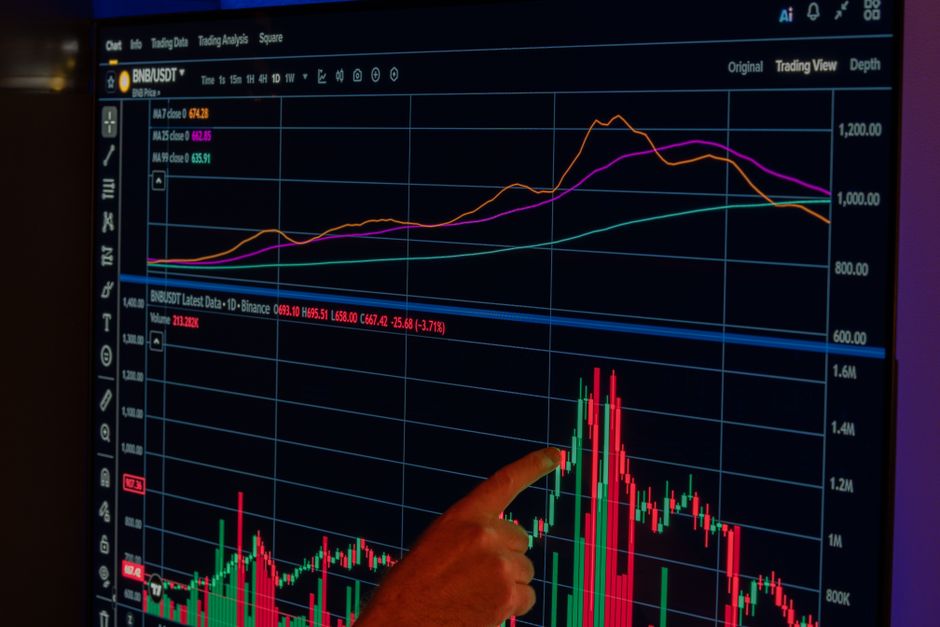
Fee schedules, supported countries and available products change often and vary by region. Confirm current terms on each platform before depositing.
| Platform | Best for | Beginner interface | Advanced tools | Check before signing up |
|---|---|---|---|---|
| Binance | Wide coin selection and trading pairs | — | — | — |
| Kraken | — | Standard app | Kraken Pro for charts and order types | Fee tier, funding methods, local rules |
| Coinbase | — | Very simple | — | Spread and fees on the simple buy screen versus Advanced |
For a first trade, use the platform's advanced or pro view where you can set limit orders.
Psychology and Discipline Checklist
Beginners rarely fail on analysis. They fail on behavior: moving a stop-loss further away, doubling down to recover a loss, or buying a coin because it just jumped 30%. Run through this before every trade:
- Did I write the entry, stop and target before placing the order?
- Is my risk 1% of my account or less?
- Am I entering because of my rule, or because the price is moving fast?
- Have I already had a losing trade today? If yes, am I trying to win it back?
- Can I accept the full stop-loss amount without stress?
- Am I using only money I can afford to lose?
- Will I log this trade whatever the result?
If you answer "no" to any of the first three, skip the trade. Missing a move costs nothing. A forced trade can cost a lot.
Common Beginner Mistakes
| Mistake | What happens | Fix |
|---|---|---|
| No stop-loss | A small loss becomes a large one | Set the stop when you enter |
| Chasing pumps | You buy near a local top | Wait for a pullback or skip it |
| Oversizing | One bad trade wipes out weeks of gains | Use the 1% rule |
| Using margin early | Liquidation can erase your balance quickly | Stay on spot trading for the first year |
| Overtrading | Fees compound against you | Cap trades per week |
| No records | You cannot tell what works | Keep the trade log |
| Falling for guaranteed-return offers | Common scam pattern | Ignore anyone promising fixed profits |
Illustrative scenario: gain and loss
These are hypothetical examples to show the mechanics, not records of real trades.
- The loss that followed the rules: A trader buys $400 of BTC at $60,665 with a stop at $57,631.75. Price drops through the stop and the position closes for a $20 loss. The account is down 1%. The rule worked as designed.
- The loss that broke the rules: The same trader removes the stop, price keeps falling 20%, and the position loses $80 on the $400. That is four times the planned loss, from one decision made under stress.
Tax Basics
Tax rules differ by country, so check your local authority. In many countries, selling, swapping one coin for another, or spending crypto can each be a taxable event. Keep your trade log with dates, prices and fees, because those records are the basis for calculating gains and losses. A qualified tax professional can handle the details for your situation.
What Experienced Editors Look For in a Beginner Plan
A usable plan fits on one page. It names the asset, the strategy, the maximum risk per trade, the maximum number of open positions and the review schedule. One common error is changing strategies after two or three losing trades, which makes it impossible to judge whether the strategy works. A better fix is to commit to a set number of trades, such as 30, and judge the results only after that. Another frequent problem is ignoring fees: on frequent small trades, a hypothetical 0.2% fee per side costs 0.4% round trip, or $1.60 on a $400 position. That alone can turn a break-even strategy into a losing one. The honest trade-off is that slow strategies like DCA earn less excitement and often less short-term profit, but they leave more room for mistakes.
Related Reading
- Pillar: Complete fintech guide
- Sibling: crypto risk management guide
- Sibling: dollar-cost averaging Bitcoin explained
- Sibling: crypto technical analysis basics
- Adjacent: how to buy Bitcoin safely
- Adjacent: stock trading strategies for beginners
- Hub: More trading articles
FAQ
What is a crypto trading strategy for beginners?
It is a written set of rules that defines which asset you trade, your entry signal, stop-loss, profit target and position size. The simplest versions are dollar-cost averaging and buy-and-hold. Swing trading is the usual first step into active trading.
How to start trading crypto with a small amount?
Open an account on a regulated exchange available in your country, paper trade for a month, then place small spot trades. Size each trade so a stop-out costs about 1% of your account. Skip margin and futures at the start.
Is it safe to trade crypto as a beginner?
It is not risk-free. Prices can fall sharply, as Bitcoin did from roughly $69,000 in 2021 to about $15,500 in 2022. Scams and exchange problems are additional risks. You reduce risk with small position sizes, stop-losses, strong account security and money you can afford to lose.
Why do most beginners lose money trading crypto?
The usual causes are oversized positions, no stop-loss, chasing price spikes, high fees from frequent trading and emotional decisions after a loss. A written plan and a trade log address most of these.
Which strategy is best for beginners: DCA or swing trading?
DCA suits people with little time who want long-term exposure. Swing trading suits people who can check charts daily and follow a stop-loss. Many beginners combine the two, using DCA for the core holding and a small allocation for swing trades.
For a complete overview, see our Crypto Trading Strategies Guide.
Disclosure: XPERTRAX (xpertrax.com) is an affiliated platform. Links and pop-ups pointing to xpertrax.com promote it. This article is for information only and is not financial advice.