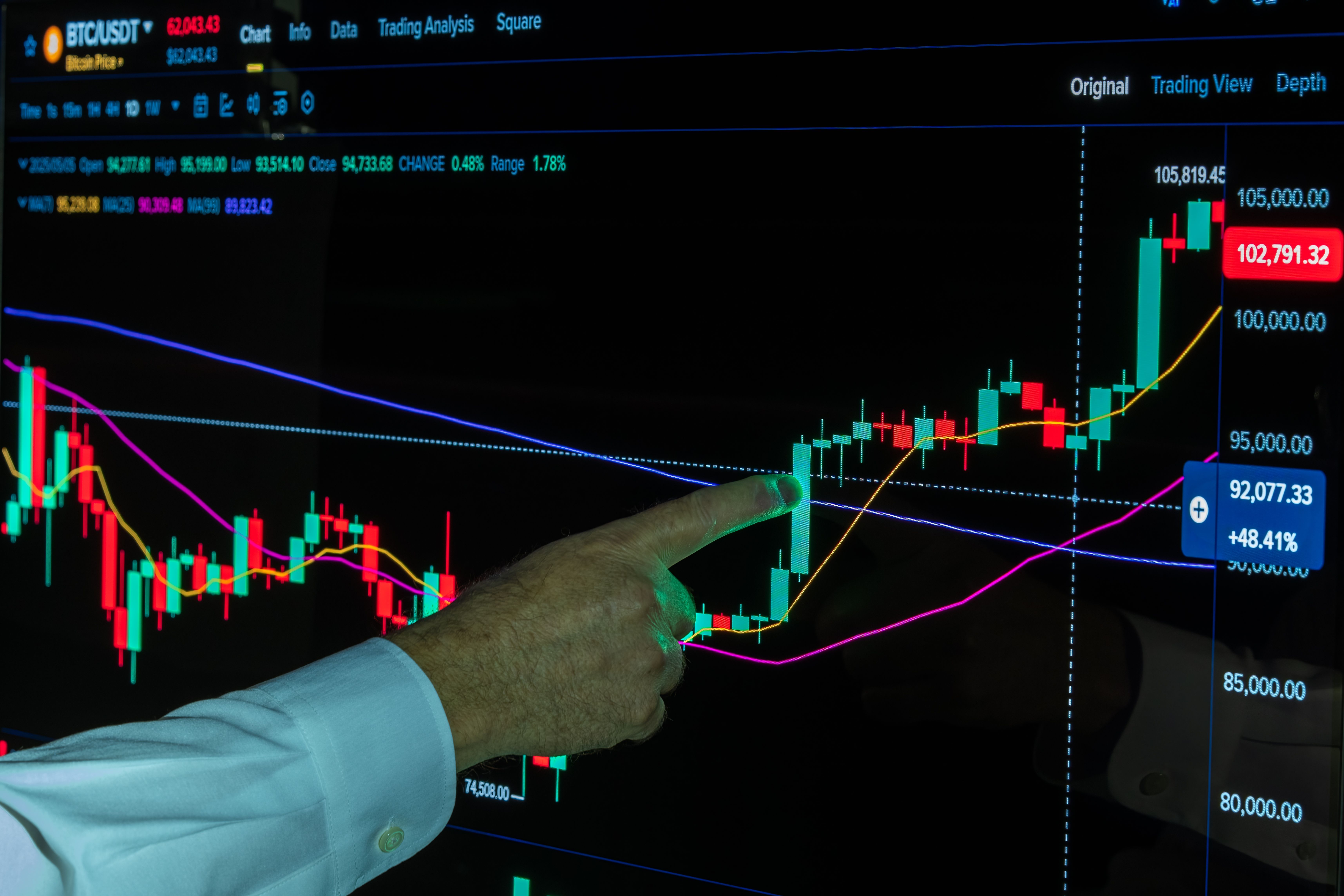
Cryptocurrency How to Trade: 7-Step Beginner's Guide
Bitcoin fell 5.28% in the last 24 hours and sits at $76,557, according to real-time market data as of October 30, 2026. Ethereum dropped 4.40% to $2,230. Days like this show who has a plan and who is guessing. This guide gives you the exact steps, the order types, the risk math and the tax basics.
Check whether a crypto platform is registered and be wary of promised returns, because scams are common in this market. Treat that as the baseline for every step below.
7 Steps to Place Your First Crypto Trade

- Choose an exchange. Pick one licensed or registered in your country. Check withdrawal support, supported coins and fee schedule before you sign up.
- Create the account. Use a dedicated email address. Set a long, unique password in a password manager.
- Verify identity (KYC). Upload a government ID and a selfie. Make sure your name matches your bank account, as mismatches can cause problems with deposits.
- Turn on two-factor authentication. Use an authenticator app or hardware key, not SMS.
- Deposit funds. Bank transfer is usually cheapest. Card deposits are fastest but often cost more.
- Open a trading pair. Example: BTC/USDT or ETH/USD. The first coin is what you buy; the second is what you pay with.
- Place a limit order and a stop-loss. Decide your entry, exit and maximum loss before you click.
Exchange Comparison: Coinbase, Kraken, Bybit, Binance
Fees and availability change by country and by account tier. Confirm current numbers on each exchange's official fee page before you deposit. The table below sticks to qualitative differences.
| Exchange | Advanced trading product | Best suited for | Key trade-off |
|---|---|---|---|
| Coinbase | Coinbase Advanced | First-time buyers who want a simple interface | — |
| Kraken | Kraken Pro | — | Interface is busier for new users |
| Bybit | Spot and derivatives platform | Active traders who want derivatives access | Availability depends on your country; check local rules first |
| Binance | Spot with advanced charts | Traders who want a wide range of coins | Product access varies by region; check eligibility |
Pick on three criteria: regulation in your country, total cost per trade, and withdrawal reliability. Skip any platform that cannot answer where it is licensed.
Fee Breakdown and a Simple Fee Calculator
Every trade has up to four costs: the trading fee, the spread, slippage and the withdrawal fee. Exchanges charge a lower maker fee when your limit order adds liquidity and a higher taker fee when your order fills immediately.
| Cost | Formula | How to reduce it |
|---|---|---|
| Trading fee | Trade value x fee rate | Use limit orders to qualify for maker rates |
| Spread | Best ask minus best bid | Trade liquid pairs like BTC and ETH |
| Slippage | Fill price minus expected price | Avoid market orders in thin books |
| Withdrawal fee | Network fee set by the exchange | Batch withdrawals; pick the right network |
Worked example (illustrative 0.10% rate, not a specific exchange): A $1,497 buy costs $1.50 to enter. Selling the same position at $1,597 costs $1.60. Round-trip fees: about $3.10. On a $50 risk, that is over 6% of your risk budget, so fees matter on small accounts.
Order Types Explained
| Order type | What it does | Main risk |
|---|---|---|
| Market | Buys or sells instantly at the best available price | Slippage in fast markets |
| Limit | Fills only at your price or better | May never fill |
| Stop-loss (stop-market) | Triggers a market sell when price hits your stop | Fills below the stop in a gap |
| Stop-limit | Triggers a limit order at the stop price | May not fill if price falls through your limit |
| Take-profit | Sells automatically at a target price | Caps upside if the move continues |
| OCO (one cancels other) | Pairs a stop and a target; one fill cancels the other | Not offered on every exchange |
Stop and limit orders work much the same way across stocks and crypto, but crypto trades 24/7, so gaps can happen at any hour.
Risk Management Worksheet
Fill these in before every trade. If you cannot, skip the trade.
| Line | Formula |
|---|---|
| 1. Account size | Your tradable balance |
| 2. Risk per trade | Account x 1% (as a rule of thumb, beginners keep it at or below 2%) |
| 3. Entry price | Where you buy |
| 4. Stop price | Where the idea is proven wrong |
| 5. Risk per coin | Entry minus stop |
| 6. Position size | Line 2 divided by line 5 |
| 7. Target price | Entry plus (risk per coin x reward ratio) |
Risk/reward ratios explained
- 1:1 needs a win rate above 50% just to break even before fees.
- 1:2 breaks even at roughly 34% wins before fees.
- 1:3 breaks even at 25% wins before fees.
Higher ratios let you be wrong more often, but targets that are too far away get hit less. Pick targets at real chart levels.
Real Trading Scenario With Numbers
This is a hypothetical example using today's Bitcoin price of $76,557 (real-time market data as of October 30, 2026). It is not a recommendation to buy.
| Item | Value |
|---|---|
| Account size | $5,000 |
| Risk per trade (1%) | $50 |
| Entry | $76,557 |
| Stop-loss | $74,000 |
| Risk per BTC | $2,557 |
| Position size | $50 / $2,557 = 0.01955 BTC (about $1,497) |
| Target (1:2) | $76,557 + $5,114 = $81,671 |
| Loss if stopped (before fees) | $50 (1% of account) |
| Gain at target (before fees) | about $100 (2% of account) |
Note that the position is only 30% of the account, yet the loss is capped at 1%. Position size is set by the stop distance, not by how confident you feel. If you used market orders and paid the illustrative 0.10% taker rate both ways, fees would take about $3.10 off each outcome.
Technical Analysis Basics for Crypto
- Support and resistance: price zones where buyers or sellers have stepped in before. Place stops just beyond them.
- Moving averages: the 50-day and 200-day averages show trend direction. Price below both means a downtrend.
- RSI: a momentum gauge from 0 to 100. Readings above 70 are conventionally called overbought, below 30 oversold. In strong trends it can stay extreme for days.
- Volume: a breakout on high volume is generally treated as more convincing than one on low volume.
- Timeframes: check the daily chart for trend, then the 1-hour chart for entry.
Indicators describe what has happened. They do not predict. Use them to define where you are wrong.
Psychology Pitfalls

- FOMO: chasing a coin after a big green candle. Fix: only enter at pre-planned levels.
- Revenge trading: doubling size after a loss. Fix: stop trading for the day after two losses.
- Moving the stop: widening it to avoid being wrong. Fix: set it once and leave it.
- Overtrading: every trade costs fees and attention. Fix: cap your trades per day.
Top 5 Costly Mistakes (With the Math)
- Using high margin. At 10x, Bitcoin's 5.28% drop today would consume 52.8% of the margin. At 20x it is 105.6%, a full liquidation. Both figures come straight from multiplying the move by the margin multiple.
- No stop-loss. A coin like Cardano at $0.1917 (down 5.31% in 24 hours) or Avalanche at $8.38 (down 5.30%) can lose a similar amount in a day. A 50% loss needs a 100% gain to recover.
- Market orders in thin pairs. The spread and slippage can eat more than the trade's expected profit.
- Wrong network on withdrawal. Sending a token over a network the receiving address does not support can lose it permanently. Send a small test first.
- Ignoring taxes. Each swap between coins can be a taxable event in many countries. Keep records from day one.
Security Checklist
- Authenticator app or hardware key for 2FA, not SMS.
- Unique password stored in a password manager.
- Withdrawal address allowlist turned on.
- Bookmark the exchange URL; never log in from email links.
- Never share seed phrases or API keys with withdrawal permission.
- Keep only trading capital on the exchange; move long-term holdings to your own wallet.
- Treat DMs offering signals, guaranteed returns or "account managers" as scams.
Tax Guidance by Jurisdiction
Rules change often. This table is a starting point. Confirm with your tax authority or a qualified accountant.
| Country | General treatment | What to record |
|---|---|---|
| United States | — | Date, cost basis, proceeds for every disposal |
| United Kingdom | — | Acquisition cost, disposal value, fees |
| India | — | — |
| Australia | — | Date and AUD value of each transaction |
| Canada | — | All trades, including crypto-to-crypto swaps |
Export your full trade history from the exchange every year, and keep the files.
How to Trade Crypto as a Beginner
- Start with BTC or ETH. They are the most liquid pairs, so spreads are tight.
- Trade spot only. No margin, no futures, until you have a written plan and a track record.
- Use an amount you can lose entirely. Your first month is tuition.
- Keep a journal: entry, stop, target, reason, result.
- Limit yourself to one or two trades a day.
- Read our technical analysis for crypto guide and our walkthrough on how to buy Bitcoin safely before adding coins.
Types of crypto trading
| Style | Holding time | Risk profile |
|---|---|---|
| Spot buy and hold | Months to years | Lowest; no liquidation |
| Swing trading | Days to weeks | Moderate; overnight gaps |
| Day trading | Minutes to hours | High; fees and attention add up |
| Margin and futures | Varies | Highest; liquidation risk |
Editor's Notes: Where Beginners Get Stuck
Four setup problems come up again and again. First, KYC rejections: a name mismatch or a blurry ID photo can cause them, and the fix is to resubmit with all four ID corners visible and matching details. Second, first deposits that sit "pending": bank transfers can take days, while card deposits settle quickly. Third, a limit buy that never fills because it was set below the current price in a rising market; check the order book depth before you place it. Fourth, a stop-limit that fails because the limit sits too far from the stop. For a fast-moving coin like Solana ($94.36, down 5.74% in 24 hours), use a stop-market order so the exit happens. The trade-off is that you accept slippage. Watch the same pairs for a week without trading to learn their normal range before risking money.
Related Reading

- Complete fintech guide
- More crypto articles
- how to trade stocks for beginners
- DeFi guides and tutorials
FAQ
What is cryptocurrency trading?
It is buying and selling coins like Bitcoin or Ethereum on an exchange to profit from price changes. You hold one asset, swap it for another, and the difference between your buy and sell price is your result, minus fees.
How to trade cryptocurrency for the first time?
Open an account on a regulated exchange, complete identity verification, enable authenticator-app 2FA, deposit funds, and place a limit order on a liquid pair. Set a stop-loss that risks no more than 1% of your account.
Is it safe to trade cryptocurrency?
Not automatically. Prices are volatile, with Bitcoin down 5.28% in a single day as of October 30, 2026, and scams are common. You reduce risk by using regulated exchanges, spot trading only, small position sizes, stop-losses and strong account security.
Why do most beginners lose money trading crypto?
The usual causes are oversized positions, borrowed funds, no stop-loss, emotional entries after big moves, and ignoring fees. Each of these can be controlled with a written plan and the risk worksheet above.
How much money do I need to start?
There is no fixed minimum. Many exchanges let you start with small amounts, but fees weigh more on small trades, so check the minimum order size and fee schedule first.
Do I have to pay tax on crypto trades?
In most major countries, yes. Selling or swapping crypto can create a taxable gain. Rules differ by country, so confirm with your local tax authority.
Disclosure: Pro Trader Daily and xpertrax.com are operated by the same owner. Links and pop-ups pointing to xpertrax.com promote our own products. This article is for information only and is not financial advice.