
What Is Stablecoin vs Bitcoin? Key Differences Explained
Put $10,000 into Bitcoin today and you own roughly 0.1243 BTC at $80,479, per real-time market data as of November 5, 2026. A 10% move either way changes your balance by about $1,000. Put the same $10,000 into a dollar stablecoin and you hold roughly 10,000 tokens that are meant to stay worth $1 each. Those two assets do different jobs, and confusing them is how traders lose money they planned to keep safe.
What each asset actually is

Bitcoin launched in January 2009 and caps its supply at 21 million coins. New coins are issued to miners, and the issuance rate halves roughly every four years. The most recent halving, in April 2024, cut the block reward to 3.125 BTC. Nobody issues Bitcoin and nobody promises its price. It trades freely against other assets on open markets.
A stablecoin is a token that tries to track an external reference, almost always the US dollar. There are three common designs:
- Fiat-backed: A company holds cash and short-term government securities against the tokens it issues. Tether (USDT) and Circle's USD Coin (USDC) are the best-known examples.
The practical point is that Bitcoin's value comes from market demand, while a stablecoin's value depends on someone or something keeping the peg intact.
Stablecoin vs Bitcoin: side-by-side table
| Factor | Stablecoin (USDT, USDC) | Bitcoin (BTC) |
|---|---|---|
| Price behavior | Targets $1, small deviations | Floats freely; $80,479 now, 24h change 4.36% |
| Supply | Expands and contracts with issuer demand | Fixed cap of 21 million |
| Who controls it | An issuer or a protocol | No issuer; open network rules |
| Main risk | Issuer, reserve and depeg risk | Price volatility |
| Can it be frozen? | Yes, major issuers can blacklist addresses | No central freeze function |
| Upside potential | None by design | High, with matching downside |
| Best use | Payments, trading base pair, cash parking | Long-term holding, store of value thesis |
| Regulatory attention | High, with dedicated frameworks | — |
The six criteria I use to compare them
When I compare two assets, I score them on what matters to the holder, not on marketing. These are the six criteria, with a plain verdict for each.
| Criterion | What to ask | Winner |
|---|---|---|
| 1. Price stability | Will $1,000 still be about $1,000 next week? | Stablecoin |
| 2. Growth potential | Can the asset appreciate? | Bitcoin |
| 3. Counterparty risk | Does value depend on a company staying solvent? | Bitcoin |
| 4. Payment usefulness | Can I spend or send it without price risk? | Stablecoin |
| 5. Censorship resistance | Can someone freeze or reverse my holdings? | Bitcoin |
| 6. Regulatory clarity | Are there clear rules for issuers and holders? | Stablecoin, in a growing number of jurisdictions |
Count them up and it is a 3-3 split. That tells you something: the right answer depends on your goal, not on a universal ranking.
5 decision rules: which one to choose

Here is how I would decide, in order of how often each situation comes up.
- You need the money in under 12 months (rent, tax bill, tuition): choose a stablecoin. A Bitcoin drawdown of 30% or more has happened repeatedly across its history, and a short timeline gives you no room to wait it out.
- You are trading and need to sit out of the market: choose a stablecoin. Moving into USDT or USDC lets you exit a position without going back to a bank. Many exchange trading pairs are quoted against them.
- You have a 4-year or longer horizon and can stomach a 50% drop: choose Bitcoin. The case for Bitcoin is its fixed supply and open market. It only works if you do not sell in a panic.
- You send money across borders: choose a stablecoin. The recipient gets dollar value, not a coin that can move 5% between sending and receiving. Check the receiving platform's supported networks first.
- You worry about issuer or government freezes: choose Bitcoin, held in your own wallet. Major stablecoin issuers can blacklist addresses. Bitcoin held with your own keys has no equivalent switch.
My pick for most readers: hold a stablecoin for anything with a deadline and Bitcoin for anything without one. Size each by how much loss you could accept, not by how excited you feel. For wallet choices, see this best crypto wallets guide.
Where each one breaks
Stablecoin failure modes
A stablecoin is only as safe as its reserves and its issuer. Three things go wrong:
- Depegging: In March 2023, USDC briefly traded well below $1 after Circle disclosed that part of its reserves sat at Silicon Valley Bank. It recovered after US authorities backed the bank's depositors, but holders who sold in the dip took a real loss.
- Freezes and blacklists: Fiat-backed issuers can freeze tokens at specific addresses when asked by law enforcement. That is a feature for compliance and a bug for anyone who wants absolute control.
Regulation is catching up. Regulation is catching up, with frameworks for stablecoin issuers emerging in several jurisdictions. Rules reduce risk but do not remove it.
Bitcoin failure modes
Bitcoin's risk is simple: the price moves a lot. Ethereum, at $2,419 with a 24h change of 6.50%, and Solana, at $95.76, show how wide daily swings run across the market. Bitcoin is usually calmer than altcoins, but it is nowhere near cash. The second risk is self-custody error. Lose your seed phrase and no one can recover the coins. See how to buy Bitcoin safely before you move a large amount.
Practical details that trip people up
Here are the specifics that matter once you move from reading to doing.
- Network mismatch is the most common stablecoin error. USDT exists on several networks, including Ethereum and TRON. If you send TRC-20 USDT to an address that only accepts ERC-20, the funds can be lost or stuck. Always confirm the network on both sides and send a small test amount first.
- Network fees differ by chain. Ethereum transfers cost gas paid in ETH, while TRON transfers consume TRX (now $0.3194). Fees change with congestion, so check the live quote in your wallet before confirming.
- Bitcoin fees depend on transaction size and demand, not the amount sent. Sending $50 and $50,000 can cost the same. Set a lower fee rate if you are not in a hurry.
- Exchange balance is not the same as ownership. Tokens left on an exchange are an IOU from that platform. For long holds, withdraw to a wallet whose keys you control.
- Stablecoin yield is not free. Platforms paying interest on stablecoins are lending your tokens or running strategies with risk. If the rate looks far above what Treasury bills pay, ask where it comes from. Our stablecoin yield risks explained piece covers this.
- Tax treatment varies. Many jurisdictions tax a swap from Bitcoin to a stablecoin as a disposal. Check local rules before rotating a large position.
For allocation, a useful rule is to split holdings by purpose. Put cash needs in stablecoins, long-term conviction in Bitcoin, and speculation in a small slice you can lose. The crypto portfolio allocation guide walks through sizing, and the Bitcoin price analysis tracks the current trend.
How the two fit in a trading workflow
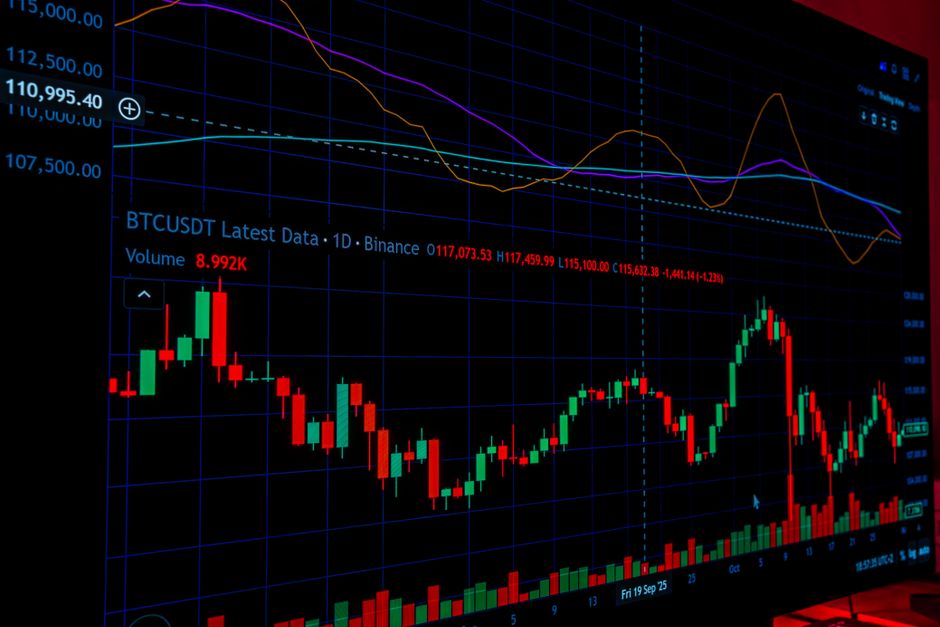
Traders use them together. A typical pattern: hold stablecoins as dry powder, buy Bitcoin on weakness, and rotate back to stablecoins when you hit a target or a stop. That pattern is one reason stablecoins are widely used as base trading pairs. If you want to compare Bitcoin against other majors first, read the Bitcoin vs Ethereum comparison. For the broader picture, the complete fintech guide and more crypto articles cover payments rails, exchanges and regulation.
Check live prices before any trade. All figures here come from real-time market data as of November 5, 2026, and crypto prices move by the minute.
FAQ
What is a stablecoin vs Bitcoin in one sentence?
A stablecoin is a token built to stay at a fixed value, usually one US dollar, while Bitcoin is a scarce digital asset whose price changes with market demand.
Is it safe to hold a stablecoin instead of Bitcoin?
It is safer from price swings, but not risk-free. You take on issuer and reserve risk, and a depeg like USDC's in March 2023 can cause losses if you sell during the dip. Pick fully reserved stablecoins from issuers that publish reserve reports.
How to choose between a stablecoin and Bitcoin?
Match the asset to your timeline. Money you need within a year belongs in a stablecoin. Money you can leave alone for four years or more can go into Bitcoin. Many people hold both.
Why do traders use stablecoins if they do not grow in value?
They act as cash inside the crypto market. Traders use them to exit positions, pay for trades, and move value across exchanges and borders without price risk.
Can a stablecoin lose its peg?
Disclosure: Pro Trader Daily and xpertrax.com are operated by the same owner. Links and pop-ups pointing to xpertrax.com promote our own products. This article is for information only and is not financial advice.