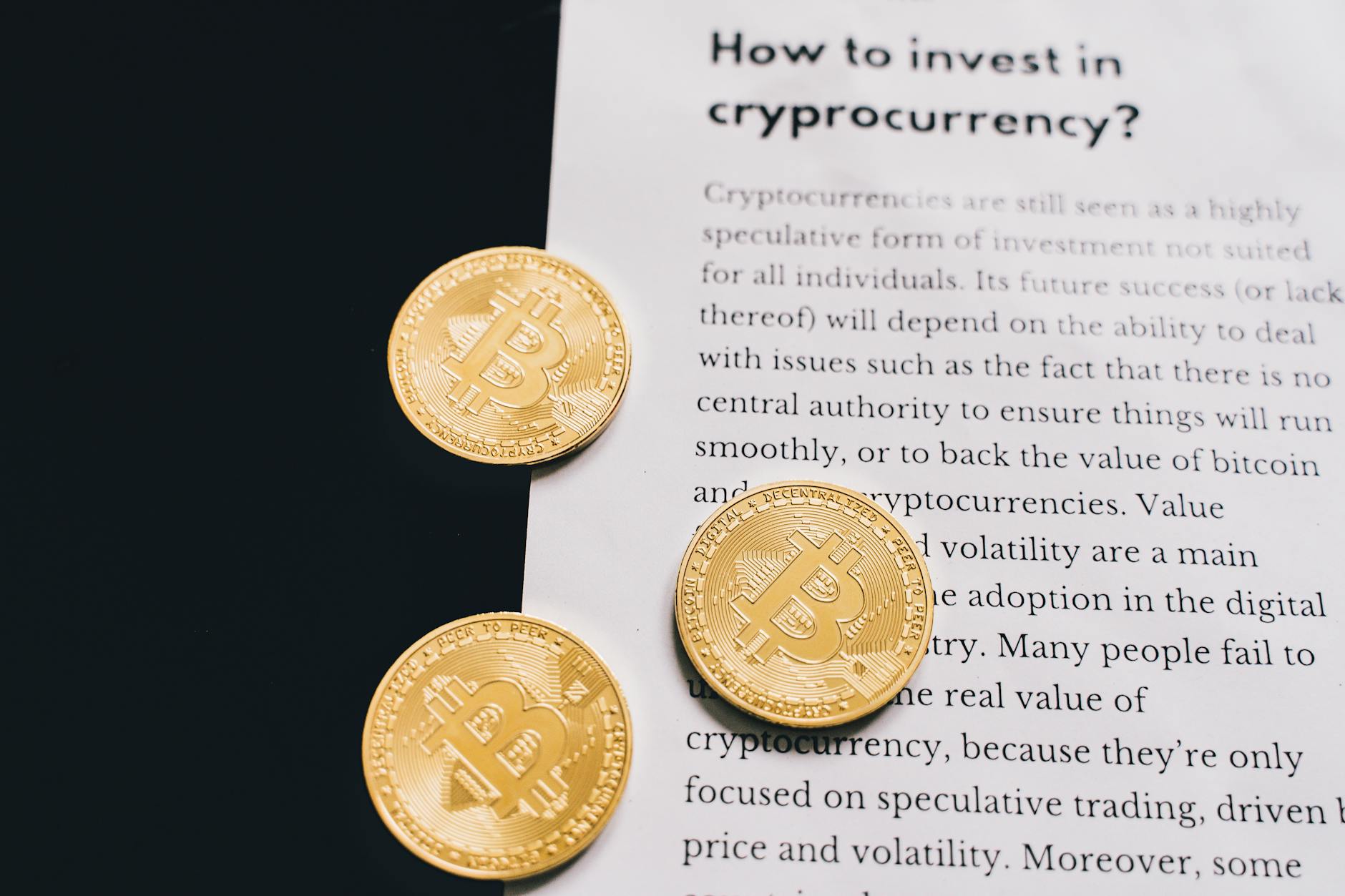
How to Trade Bitcoin for Beginners: Master the Basics in 7 Steps
You've heard about Bitcoin. You've seen the headlines about traders making thousands in days. But you're sitting on the sidelines because the learning curve feels impossible, and the fear of losing money feels very real.
Here's the truth: Bitcoin trading isn't rocket science, but it requires discipline, a solid plan, and understanding the actual mechanics before you risk a single dollar. Most beginners fail not because they lack intelligence—they fail because they skip the fundamentals and chase quick profits.
This guide walks you through exactly how professional traders start: the right exchange choice, account security, position sizing, and the psychological rules that separate winners from liquidated accounts. By the end, you'll have a concrete action plan—and you'll know precisely what not to do.
Step 1-7: The Complete Bitcoin Trading Roadmap
Step 1: Choose Your Exchange (Regulation & Fees Matter)
Your exchange is your trading infrastructure. Choose wrong and you'll overpay on fees, lose access to your funds, or face regulatory issues.
What you need:
- Regulatory license in your jurisdiction (SEC-registered in the US, FCA-regulated in the UK, MAS-approved in Singapore)
- Transparent fee structure with no hidden charges
- Mobile app for on-the-go monitoring
- Deposit methods you actually have (bank transfer, debit card, PayPal)
- 24/7 customer support (critical if something breaks)
Why regulation matters: Unregulated exchanges can disappear overnight. Your funds get frozen. You have zero recourse. Coinbase and Kraken hold insurance on customer deposits. Unregulated exchanges do not.
Step 2: Create and Verify Your Account
You'll need:
- Valid government ID (passport or driver's license)
- Proof of address (utility bill, bank statement)
- Email address you actively monitor
- Phone number for SMS verification
The entire process takes 10-30 minutes. Verification (KYC compliance) can take 24-48 hours. During this wait, read through the exchange's trading interface—don't just stare at charts.
Step 3: Set Up 2-Factor Authentication (Non-Negotiable)
This single step prevents 99% of account takeovers. Use an authenticator app, not SMS when possible.
Recommended apps:
- Google Authenticator
- Authy
- Microsoft Authenticator
Why not SMS? SIM swapping attacks let hackers intercept SMS codes. Authenticator apps store the code on your device—no phone network exposure.
Step 4: Deposit Funds (Start Small)
Most exchanges offer bank transfers, debit/credit cards, and PayPal. Bank transfers are cheapest (0-1% fee). Debit cards are fastest but costlier (2-4% fee).
Golden rule for beginners: Deposit only what you can afford to lose completely. If losing $500 would hurt your emergency fund or rent, deposit less or don't trade yet.
Step 5: Execute Your First Trade
Navigate to the trading pair BTC/USD (or BTC/GBP if UK-based). You'll see two order types:
Market Order: Buy immediately at the current price (Bitcoin at $63,121 right now). Executes instantly. Slippage risk if volume is low.
Limit Order: Set a maximum price you'll pay ($62,500). Waits until the price drops. Takes longer but saves on fees.
For beginners: Use limit orders. You control the price. Yes, it waits. That's fine.
Step 6: Monitor Your Position (Actively, At First)
Set price alerts on your phone. Most exchanges let you set notifications at +5% and -5% from entry. Check your position once daily, not 20 times hourly. Overmonitoring triggers emotional decisions.
Step 7: Exit the Trade (Know Your Rules Before You Enter)
This is where most beginners fail. They enter without an exit plan, hold through losses hoping to "break even," and watch a -10% dip turn into -60%.
Professional rule: Before you buy, decide two numbers:
- Take-profit level: "If Bitcoin hits $66,000, I'm selling 50% of my position."
- Stop-loss level: "If Bitcoin drops to $60,000, I'm selling all of it—no second-guessing."
Write these down. Stick to them. Emotions cloud judgment; rules prevent catastrophe.
Exchange Comparison: Coinbase vs Kraken vs Binance
| Exchange | Maker Fee | Taker Fee | Deposit Fee | Withdrawal Fee | Best For |
|---|---|---|---|---|---|
| Coinbase | 0.5% | 0.5% | Free (ACH) / 1.5% (card) | Free | US beginners, bank transfers |
| Kraken | 0.16% | 0.26% | Free | $0.15-$1 | Low fees, advanced charts |
| Binance | 0.1% | 0.1% | Free | Varies by coin | Highest volume, most altcoins |
Real-world example: You're buying $1,000 of Bitcoin.
- Coinbase: $1,000 deposit fee (free via bank, $15 via card) + $5 trading fee = $20 cost. Total in: $1,020.
- Kraken: $0 deposit + $2.60 trading fee = $2.60 cost. Total in: $1,002.60.
- Binance: $0 deposit + $1 trading fee = $1 cost. Total in: $1,001.
On a small $1,000 trade, Binance saves you $10-18. On $50,000 trades over a year, the difference is $500-900. Fee structure compounds.
Beginner recommendation: Start on Coinbase or Kraken. Both are regulated in multiple jurisdictions, have intuitive interfaces, and won't confuse you with 1,000 altcoins on the homepage. Once comfortable with the mechanics, consider Binance for lower fees.
The 2% Rule: Risk Management for Beginners
Professional traders follow one core rule: never risk more than 2% of your total account on a single trade.
Why 2%? If you have 50 consecutive losing trades (statistically very likely), you'll be down 64% but still able to recover. At 5% per trade, 20 losses wipes you out.
How to apply it:
Account size: $5,000
2% of account: $100
If your stop-loss is $62,500 (i.e., you'll exit at a loss if Bitcoin drops to $62,500):
- Entry price: $63,121
- Stop-loss: $62,500
- Risk per trade: $621
- Position size: $100 ÷ $621 = 0.16 BTC (roughly)
The formula:
Position Size = (2% of Account) ÷ (Entry Price - Stop Price)
This single calculation separates accounts that survive from accounts that blow up.
Security Checklist: Protect Your Account Before Trading
Essential security steps (non-negotiable):
- Enable 2FA with an authenticator app (not SMS). Store backup codes offline in a safe.
- Use a unique, 16-character password (no birthdays, pet names, or dictionary words). Use a password manager like 1Password or Bitwarden.
- Never share your recovery phrase or private keys with anyone—not support staff, not friends, not family. Exchanges will never ask for these.
- Enable login notifications. If someone tries to access your account from a new device, you'll know immediately.
- Whitelist withdrawal addresses. After 48 hours, your exchange won't let you withdraw to a new address without a second 2FA confirmation.
- Use a hardware wallet for amounts over $5,000. A Ledger Nano X costs $79 but protects six figures. The ROI is obvious.
- Never use public WiFi to access your exchange. VPN or mobile data only.
- Disconnect unused API keys. If you've experimented with trading bots, delete those API connections from your exchange settings.
Real Trade Example: From Entry to Exit
Scenario: You have $2,000 in your Kraken account. Bitcoin is at $63,121. You believe it's oversold and will bounce to $67,000 within 2 weeks.
Your trade plan:
- Entry: $62,800 (limit order, hoping for a $300 dip)
- Exit (profit): $66,500 (target of +5.9%)
- Exit (loss): $61,500 (stop-loss at -1.9%)
- Risk: $62,800 - $61,500 = $1,300
- Position size: ($2,000 × 2%) ÷ $1,300 = 0.0308 BTC
Your order on Kraken: Place a limit buy order for 0.0308 BTC at $62,800. Simultaneously, set a stop-loss sell order for 0.0308 BTC at $61,500 and a limit sell order at $66,500.
Outcome A (Profitable): Bitcoin dips to $62,800, your buy executes. Three days later it spikes to $66,500. Your limit sell executes. You're out with a $112 profit after fees (5.6% return on your $2,000).
Outcome B (Loss): Bitcoin never dips. Instead, it drops to $61,200. Your stop-loss triggers. You're out with a $40 loss (2% of your account—exactly as planned). You're still solvent and can trade again.
Why this works: You defined risk before entering. Emotion can't override a pre-set stop-loss.
The 8 Mistakes That Destroy Beginner Accounts
1. Trading Without a Stop-Loss
This is the #1 killer. You buy Bitcoin at $63,000, it drops to $60,000, and you hold hoping it bounces. It doesn't—it crashes to $40,000. You lost 37% instead of the planned 2%.
Solution: Set stop-loss before entering. No exceptions.
2. Using Leverage / Margin Trading
Margin lets you borrow money to increase position size (e.g., 5x leverage = control 5x your account). Beginners love this. Professionals avoid it. One bad trade wipes you out instantly.
Solution: Avoid leverage entirely. Trade what you have. When you're profitable without leverage, maybe reconsider.
3. Panic Selling After Small Losses
Bitcoin drops 3%. You panic and sell at the bottom. It rebounds 10% the next day. You've locked in a loss and miss the recovery.
Solution: Your stop-loss defines "bad enough to exit." Below that? It's noise. Ignore it.
4. Chasing FOMO (Fear of Missing Out)
You see Bitcoin up 15% today. You buy at the peak. Tomorrow it crashes 8%. You panic and sell for a loss.
Solution: Trade your plan, not the charts. Don't buy because others are buying.
5. Trading Altcoins Before Learning Bitcoin
Beginners see "cheap" coins like Dogecoin at $0.07 and think they'll 100x. Most crash to zero. Bitcoin is harder to liquidate and easier to analyze.
Solution: Master Bitcoin trading for 3-6 months. Only then add altcoins.
6. Overtrading (Entering Too Many Positions)
You see an opportunity every day. You open 10 positions. You can't monitor them. You miss exits. Account explodes.
Solution: Beginners should trade 1-2 positions maximum. Quality over quantity.
7. Ignoring Fees
You trade $5,000 every day for 30 days. At 0.5% fees, you've lost $7,500 in fees alone. You'd need 50%+ returns just to break even.
Solution: Use low-fee exchanges. Trade less frequently but with higher conviction.
8. Storing Coins on Exchanges Long-Term
Exchange hack or bankruptcy = your coins are gone. Always withdraw to a wallet you control (hardware wallet or secure software wallet).
Solution: Keep only active trading amounts on the exchange. Withdraw profits weekly to cold storage.
Tax Implications: What Beginners Don't Know
Spoiler: Bitcoin is taxable. Every single trade is a taxable event. Ignoring this causes an audit nightmare.
US Rules (IRS):
- Each buy/sell is a capital gain or loss
- Short-term gains (held less than 1 year): taxed as ordinary income (up to 37%)
- Long-term gains (held 1+ year): taxed at 0%-20% depending on income
- You must report every trade on Form 8949 and Schedule D
- Failure to report = penalties up to 75% of unpaid tax + criminal liability
UK Rules (HMRC):
- Capital Gains Tax on profits (10%-20% depending on annual allowance)
- Income Tax if trading is your main activity (20%-45%)
- Must keep records for 5 years
Practical approach for beginners:
- Use tax software like CryptoTrader.Tax or Koinly (they auto-import exchange data)
- Cost: $30-50 per year. Much cheaper than accountant fees.
- Export a report once per quarter. Gives you a real picture of P&L.
- Keep all receipts and trade records (exchanges keep these for 7 years)
- If you trade actively, consult a tax professional before April
Real example: You made $3,000 profit trading Bitcoin over 8 months (short-term gains). At 30% tax rate, you owe $900 to the IRS. If you didn't plan for this, you're forced to sell Bitcoin to pay the bill—which triggers more taxes.
How Long Until You're Profitable? Honest Truth
Social media shows millionaires made in 30 days. Reality is different.
Month 1-2: You're learning the interface, making small trades ($100-500 each), and probably breaking even or down 2-5%. This is normal. You're paying tuition to the market.
Month 3-4: You've placed 20-30 trades. Some worked, some didn't. You've spotted two-three patterns that seem to repeat. Win rate improves to 45-50%.
Month 5-12: By month 6, you should have 50+ trades logged and can evaluate if your strategy actually works. Profitable traders average 40-win rates that vary significantly but with larger wins than losses. Unprofitable traders have 55-win rates that vary significantly but small wins and huge losses.
After 1 Year: If you've been disciplined (following the 2% rule, keeping a trade journal, reviewing losses), there's a realistic chance of 15-25% annual returns. That's $300-500 per $2,000 invested. Not a fortune, but solid.
The brutal stat: Industry data shows 85% of retail traders are unprofitable after 1 year. The 15% who survive all followed three rules:
- Risk management (2% rule)
- Trading journal (tracking every trade)
- Emotional discipline (no revenge trading)
You don't need to be a genius to be in the 15%. You need discipline.
Frequently Asked Questions
Is Bitcoin trading safe for beginners?
Bitcoin trading is safe if you follow three rules: use a regulated exchange, enable 2FA, and use a stop-loss on every trade. The market itself is risky (you can lose money), but the infrastructure is secure. Most losses are from poor strategy, not hacked accounts.
How much money do I need to start?
Technically, some exchanges let you start with $10. Practically, you need $500-1,000 minimum. Why? Below that, fees eat your returns. A $100 trade with 0.5% fee ($0.50) is a huge percentage loss before price movement even happens.
What's the difference between trading and investing?
Investors buy and hold for years, betting on long-term appreciation. Traders buy and sell within days/weeks, trying to profit from price swings. Beginners often think they're investing but actually trade impulsively—the worst combination.
Can I trade Bitcoin with my phone?
Yes. All major exchanges have mobile apps. However, phones are less secure than desktops (easier to lose, more vulnerable to malware). Use your phone to check positions, but place large trades on a desktop with a VPN.
What's the difference between a hot wallet and cold wallet?
Hot wallet: Connected to the internet. Fast, convenient, less secure. Use for active trading. Examples: Coinbase account, MetaMask.
Cold wallet: Offline. Slower but ultra-secure. Use for long-term storage. Examples: Ledger Nano X, Trezor.
For amounts over $5,000, use cold storage.
Should I use leverage or margin?
No. Not as a beginner. Leverage amplifies losses as much as gains. One 50% leveraged position that moves 3% against you can liquidate your entire account. The only traders who succeed with leverage are professionals with risk systems. You're not there yet.
What should I do if I lose money?
First, don't panic or revenge trade. Second, review your trade journal. Why did the trade fail? Was it your strategy or just bad luck? Third, if it was your strategy's fault, tweak it and test on a demo account (many exchanges offer paper trading). Never go back to a losing strategy.
Do I need to report small trades to the IRS?
Yes. The IRS considers even $0.01 of profit a taxable event. However, below $600 annual profit, you may not receive a 1099 form. Still report it. The burden is on you to file accurately, not on the exchange to report it to the IRS.
"The goal of a successful trader is to make good trades. Consistency, discipline and an accepting attitude toward small losses are the most important factors." — Alexander Elder, professional trader and author of Come Into My Trading Room
Next Steps: Your Action Plan
You now understand Bitcoin trading mechanics, position sizing, security, and the realistic timeline. Here's what to do right now:
- Sign up on Kraken or Coinbase (whichever accepts users in your country)
- Complete KYC verification (takes 24-48 hours)
- Set up 2FA with Google Authenticator (not SMS)
- Deposit your first $500 via bank transfer (lowest fees)
- Place your first limit order at least 1-2% below the current price (patience builds profit)
- Set your stop-loss and take-profit before hitting enter
- Start a trade journal (Google Sheets works fine—document entry, exit, reasoning, result)
According to Investopedia, keeping a detailed trade journal increases long-term profitability by 40-60% because it forces you to confront your mistakes instead of rationalizing them.
Your first goal isn't to make money. It's to survive 50 trades without blowing up your account. That alone puts you ahead of 85% of beginners.
Explore Advanced Bitcoin StrategiesRelated Reading
- Cryptocurrency Trading Guides
- Secure Bitcoin Storage: Hardware Wallet Review
- Complete Risk Management Framework for Traders
- Crypto Tax Guide: Reporting Requirements by Country
- Decentralized Finance (DeFi) for Beginners
- Fintech Innovation and Trading Technology
- Technical Analysis Fundamentals
- Back to Crypto Hub